

Media agreement for children: shared rules instead of daily arguments
«Just five more minutes!» – arguments about phones, tablets and games are part of everyday life in many families. A media agreement that you make and sign together creates clarity for everyone. Here you'll find rules by age, tips and a template to adapt and print.
Why an agreement works better than a ban
Children are more likely to stick to rules they helped to shape. A written agreement makes clear what applies – even when it's late and everyone is tired. And it applies to everyone: if you expect no phone on the table at dinner, you put yours away too.
It's not about controlling, but about guiding. More important than any minute is that children know: if something goes wrong online, they can tell you – without getting into trouble.
Which rules suit which age?
A common rule of thumb is «3-6-9-12» by the French psychiatrist Serge Tisseron: no screens before 3, no games console of their own before 6, internet only from 9 and with support, social networks from 12 at the earliest. The suggestions below are a starting point – adapt them to your child.
Up to 6 years
- We watch screens together – not alone.
- At most 30 minutes a day, with breaks.
- No screens at mealtimes or before going to sleep.
- Tablet and phone stay in the living room.
- When the alarm rings, time's up.
- Mum and Dad put their phones away too when we're together.
School children (7–12)
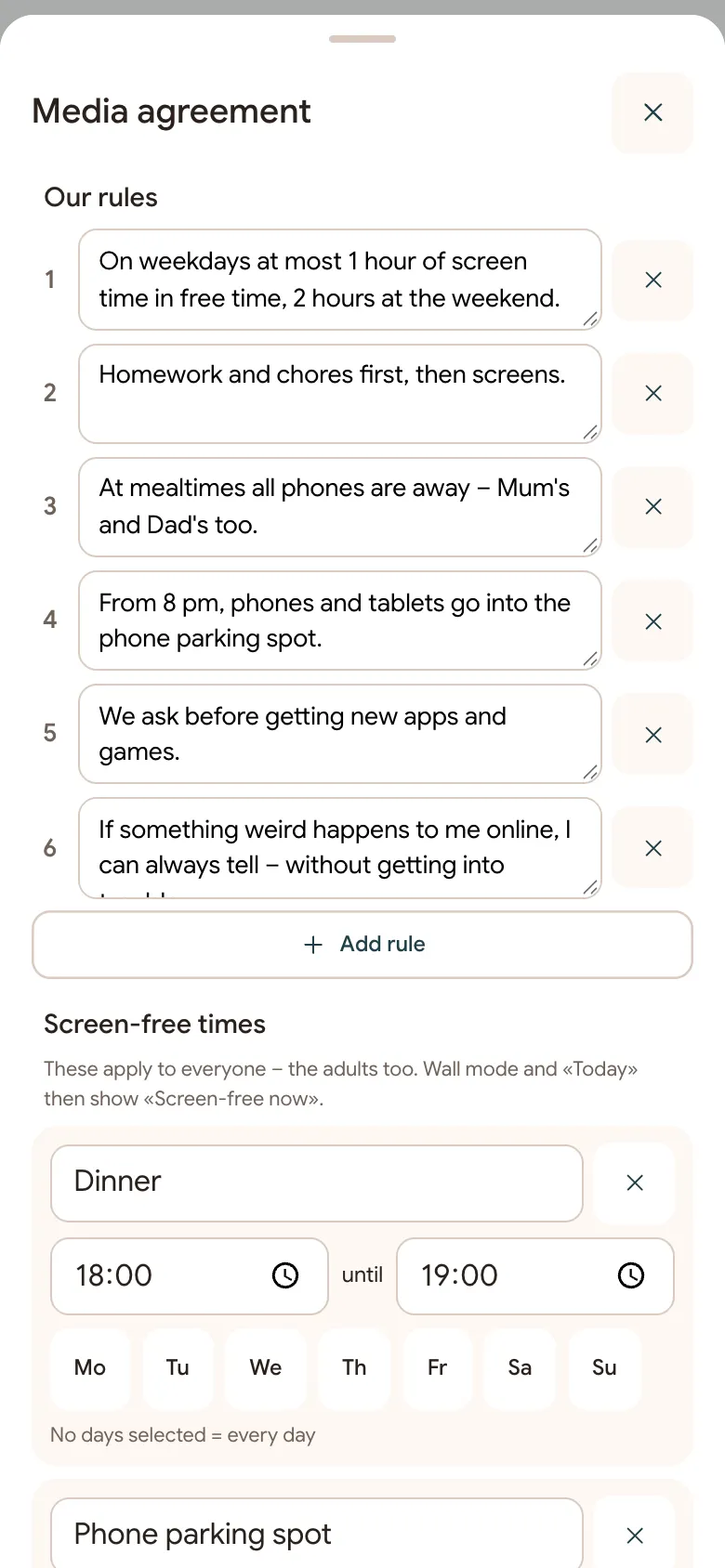
- On weekdays at most 1 hour of screen time in free time, 2 hours at the weekend.
- Homework and chores first, then screens.
- At mealtimes all phones are away – Mum's and Dad's too.
- From 8 pm, phones and tablets go into the phone parking spot.
- We ask before getting new apps and games.
- If something weird happens to me online, I can always tell – without getting into trouble.
Teenagers (13+)
- We honestly estimate our screen time and talk about it once a week.
- Phones stay away at mealtimes and during family time.
- At night the phone sleeps outside the bedroom.
- No photos or videos of others without their consent.
- Homework and sleep come first.
- If something goes wrong online, we get help together.
5 tips for your media agreement
- Work it out together. Sit down at a table when everyone is relaxed – not right after an argument. Everyone may make suggestions.
- Few, clear rules. Five to eight rules are enough. «Phone parking spot from 8 pm» is clearer than «not too late».
- Screen-free times for everyone. Dinner, a family outing, the hour before bed: what applies to the children applies to the adults too.
- Have alternatives ready. Screen time goes down above all when there's something else exciting to do – games, books, being outdoors.
- Adjust regularly. What fits at 8 is too tight at 11. Look at the agreement together every few months.
Media agreement template to print
Choose the age, tick rules on or off or add your own, enter screen-free times and the names for the signatures – and your agreement is ready on A4 portrait. Free, no account. Your entries stay on this device and are not sent anywhere.
Preview (A4 portrait)
A family app for less screen time and more family.
FamilyBuddy helps you guide screen time instead of controlling it – without tying children to the screen.
- Media agreement with templates by age – adapt it together, everyone agrees, print it and hang it up
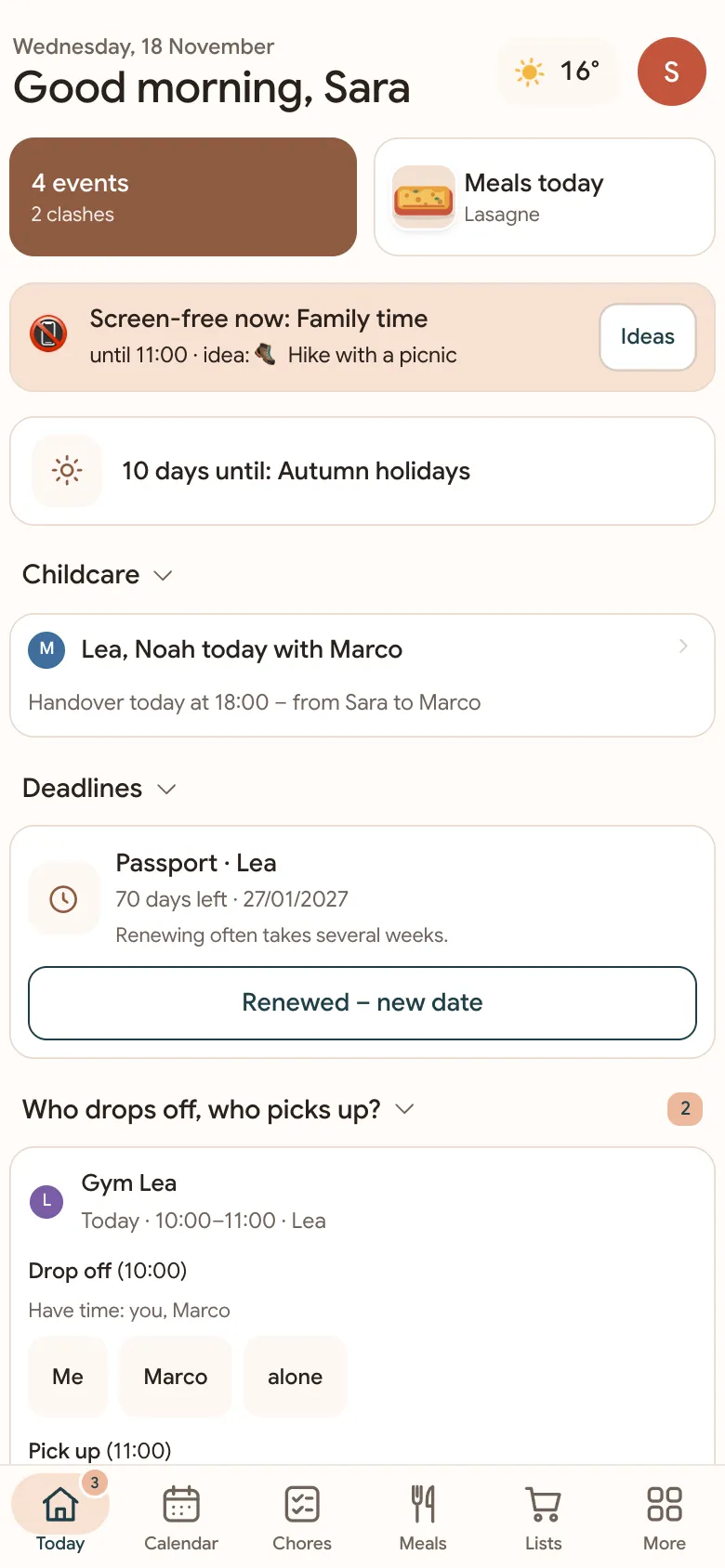
- Screen-free times for everyone: «Screen-free now» shows on «Today» and on the kitchen tablet
- «What shall we do instead?» – ideas by weather, age and time, added to the family calendar with one tap
- No tracking: FamilyBuddy doesn't measure screen time and doesn't monitor anyone
CHF 5 per month for the whole family, data in Switzerland. More on the home page · Guide · Info sheet for schools (German)
Frequently asked questions about the media agreement
How much screen time is OK for children?
There is no fixed number. For young children: as little as possible and together. For school children and teenagers, besides the duration, what matters most is the content, enough sleep, exercise and time with others.
When should a child get their own phone?
That depends on the child and the situation, such as the way to school. Many families wait until the move to secondary school. More important than the age is agreeing on clear rules beforehand – that's exactly what a media agreement is for.
What is the 3-6-9-12 rule?
A rule of thumb by the French psychiatrist Serge Tisseron: no screens before 3, no games console of their own before 6, internet only from 9 and with support, social networks from 12 at the earliest.
What happens if someone doesn't stick to the agreement?
It's best to agree on this when you create it, for example less screen time the next day. Stay calm and talk together after a few weeks about whether the rules still fit.
Does the agreement apply to parents too?
Yes, at least the screen-free times. Children take a lot of their cues from adults. That's why everyone signs the template.
Is the template free and do I need an account?
Yes, the template is free and needs no account. Your entries stay on your device only and are not sent anywhere. FamilyBuddy doesn't measure screen time and doesn't monitor anyone.
Is there an app for the media agreement?
Yes. In the family app FamilyBuddy you set up the media agreement together with templates by age, decide on screen-free times and get ideas for what to do instead. FamilyBuddy doesn't measure screen time and doesn't monitor anyone. The app runs in the browser on iPhone, Android, tablet and computer – no download from the App Store. The first month is free. Try for free
Read more: jugendundmedien.ch – Swiss national platform for youth and media (German, French, Italian)