

Co-parenting after separation: a parenting plan that works for everyone
Two homes, one goal: the children should know where they are and when – and you don't want to renegotiate every week. Here you'll find the common parenting models, what belongs in a good plan, how to share costs fairly, and a template to try out and print your rhythm.
The common parenting models
Which model fits depends on the children's age, how far apart the two homes are and your working hours. The percentage shows how many days the children spend with the second parent.
Weekly switch 50 %
One week here, one week there. Few handovers, calm weeks. Often suits school children if both homes are in the same school catchment area. For young children a week can be long.
2-2-3 50 %
Two days here, two days there, three days here – the other way round the following week. Short separations from both parents, but many handovers. Often chosen for toddlers.
2-2-5-5 50 %
Monday and Tuesday always with one parent, Wednesday and Thursday always with the other, and the weekends including Friday alternate. Fixed weekdays make hobbies and school easier.
Every 2nd weekend 14 %
The children mainly live with one parent and spend every second weekend with the other. Often a fixed evening during the week or part of the holidays is added.
There are also many individual solutions, for example 60/40 because of working hours. What matters is not the model, but that it is reliable for the children.
What belongs in a good parenting plan
- The rhythm. Which model, from which date – and who the children are with in the first week.
- The handovers. When and where: after school, in the evening, at the front door? Who drops off, who picks up? Handovers at school or nursery spare the children goodbye scenes.
- Holidays and public holidays. How are the school holidays shared? Christmas, Easter and birthdays alternating every year – agreeing on this in good time prevents arguments in December.
- Rules for swapping. How early do you ask, how quickly does the other parent reply, and is a swapped day given back?
- Costs. What does maintenance cover, and how are extras such as school camp, the dentist or a new bike shared?
Parenting plan template to print
Choose a rhythm, set the start date – the template shows the next 12 weeks, who has the children on which day and when the handovers are. A4 landscape, free, no account. Your entries stay on this device and are not sent anywhere.
Preview
Sharing expenses fairly
What maintenance covers is set out in your agreement or the court decision. On top of that there are often extras: school camp, braces, music school, ski equipment. It helps to agree beforehand which expenses you share, in what ratio – 50/50 or according to income – and above which amount you talk to each other first.
Record expenses as they come rather than at the end of the year, and settle up regularly, for example every month. That way many small amounts don't turn into one big point of conflict.
Swapping without arguments
A business trip, a birthday party, grandparents visiting: swaps are part of it. What helps: ask early, keep it short and factual, say clearly which day comes back in return – and keep answers in writing. That way nobody remembers «something else» later.
And: the children are not the messengers. Arrangements are made between the parents, not via the school bag.
Co-parenting app: two homes, one plan for the children.
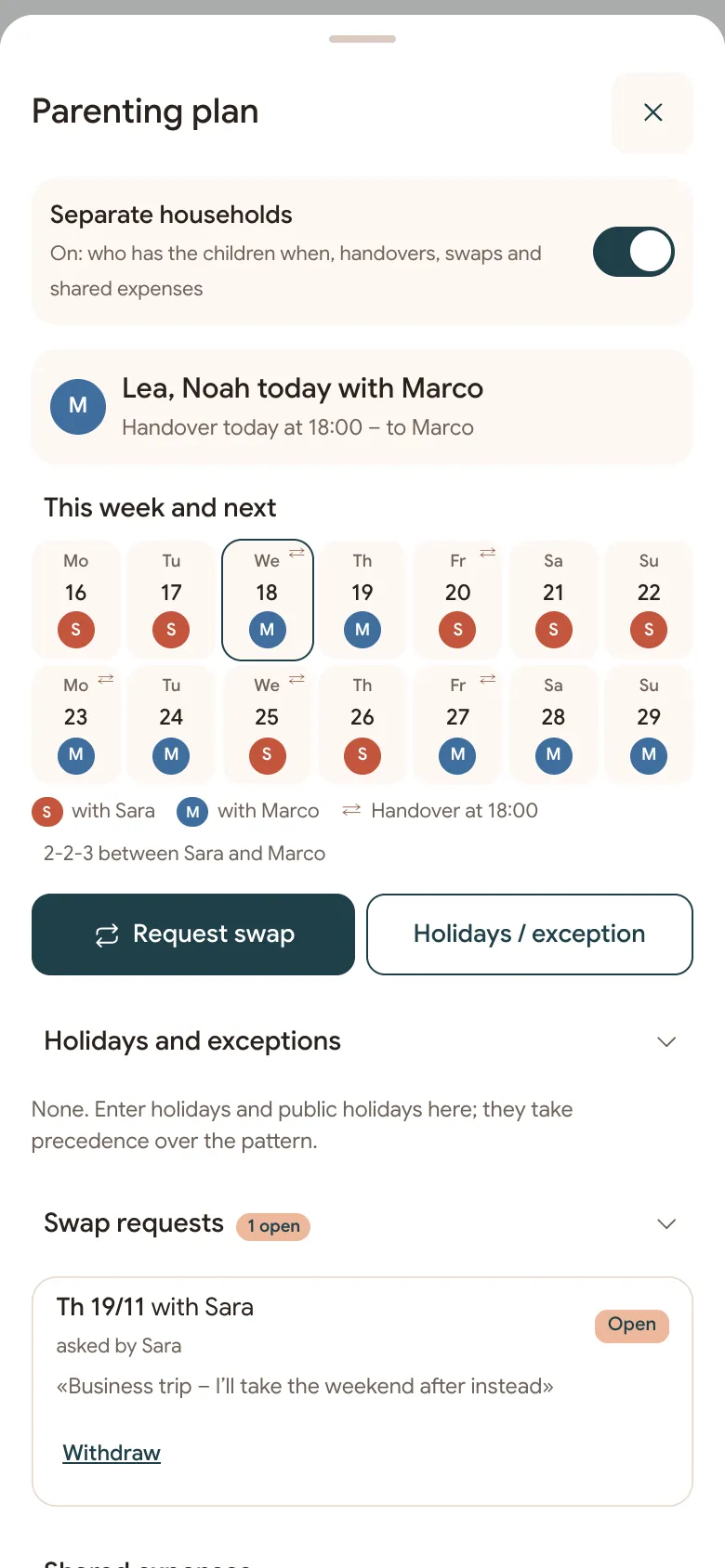
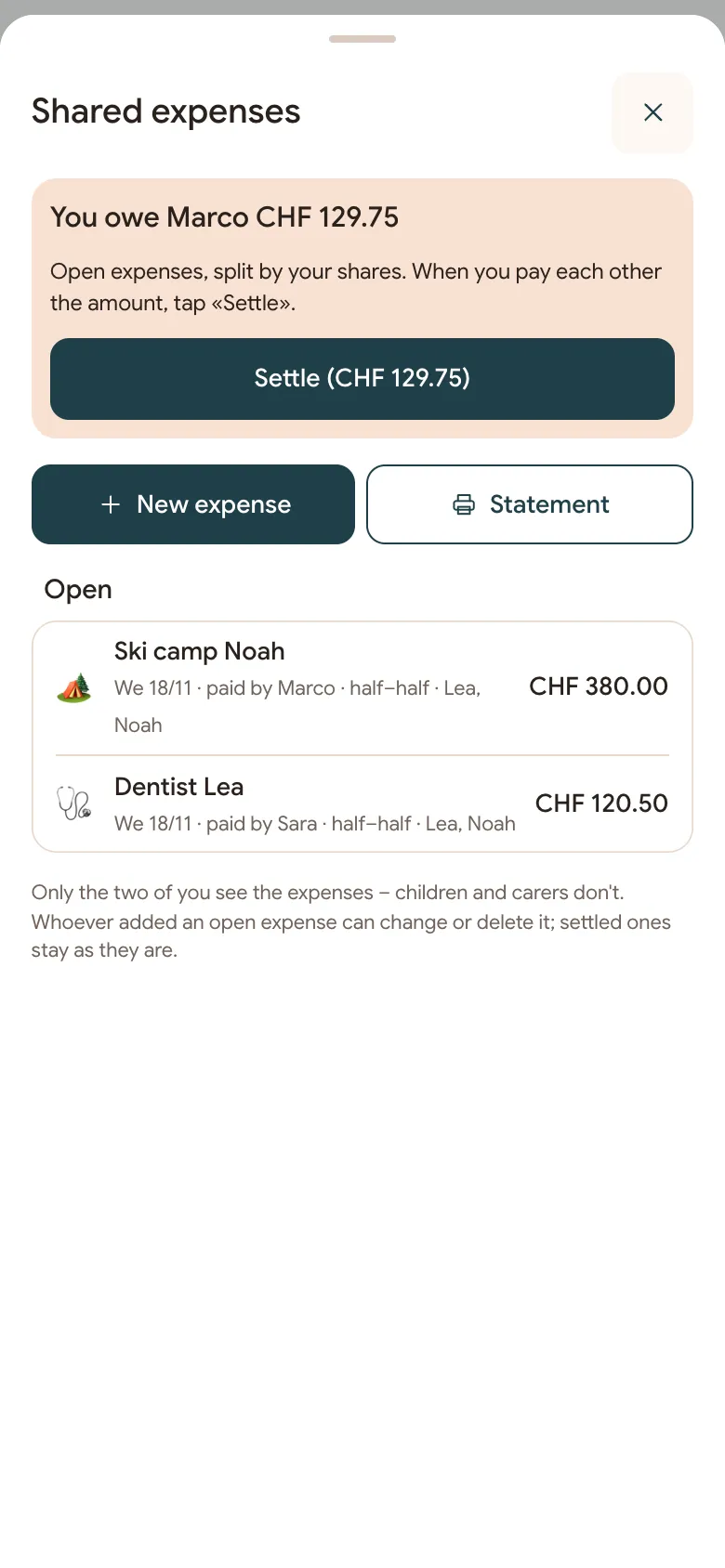
FamilyBuddy keeps the plan, swap requests and shared expenses in one place – factual and easy to follow.
- Weekly switch, 2-2-3, 2-2-5-5, every 2nd weekend or a custom pattern – with handover time and place, holidays and exceptions
- Request a swap: the other parent answers yes or no, the plan adjusts, and everything stays in the history
- Record shared expenses, split them by share, settle up and print a statement – only the two parents can see them
- Private stays private: your own calendars as «only me», «busy only» or «important only» – also towards the other parent
- A reminder on handover day – for parents and for children, who can see where they are today
CHF 5 per month for the whole family, data in Switzerland. More on the home page · Guide to the parenting plan
Frequently asked questions about the parenting plan
Which parenting model is the right one?
That depends on the children's age, the distance between the two homes and your working hours. Young children often cope better with shorter intervals, such as 2-2-3. School children appreciate fixed weekdays or a weekly switch. Try a model for a few weeks and adjust it together.
What is the difference between 2-2-3 and 2-2-5-5?
With 2-2-3 the days change every week: whoever has Monday and Tuesday this week has Wednesday and Thursday next week. With 2-2-5-5, Monday/Tuesday and Wednesday/Thursday always stay with the same parent, and only the weekends alternate.
How do we handle holidays and public holidays?
Many parents split the school holidays in half and alternate Christmas, Easter and birthdays every year. Put the agreement in writing and enter the holidays early in the year. In FamilyBuddy these are exceptions in the plan that replace the normal rhythm for those days.
Who pays for extras such as school camp or the dentist?
What child maintenance covers is set out in your agreement or the court decision. For extras, a fixed arrangement helps, for example 50/50 or according to income, plus an amount above which you talk to each other first. If in doubt, a counselling service or mediation can help.
Do both parents need to use FamilyBuddy?
For swap requests and shared expenses, yes: both parents are in the same FamilyBuddy family. Your own calendars can stay private or appear only as «busy». The subscription of CHF 5 per month covers the whole family.
Is the template free and do I need an account?
Yes, the template is free and needs no account. Your entries stay on your device only and are not sent anywhere. FamilyBuddy does not replace legal or family counselling.
Is there an app for separated parents?
Yes. In the family app FamilyBuddy you keep the parenting plan, swap requests and shared expenses in one place – factual and easy to follow. Your own calendars stay private if you like, also from the other parent. The app runs in the browser on iPhone, Android, tablet and computer – no download from the App Store. The first month is free. Try for free
Support with separation and parenting questions: Places families can turn to