

Chore chart for children – how it works without arguments
Who sets the table today? Who takes the paper recycling down? With a clear chore chart – in Switzerland it's called an «Ämtliplan» – everyone knows what's due, and you have to remind less. Here you'll find suitable chores for every age, tips for a fair chart and a template to print.
Which chores suit which age?
Even the youngest can help: a two-year-old likes putting socks in the basket. Fixed chores that a child is responsible for on their own usually work from kindergarten. The list is a suggestion – every child is different. Better choose something a little too easy that works than something too hard that frustrates.
3 to 5 years
Kindergarten: helping and first own chores
- Tidy up toys
- Water the plants
- Sort socks
- Hand out napkins
- Put away the shopping
- Feed the pet
6 to 8 years
Lower primary: small tasks on their own
- Set the table
- Clear the table
- Make the bed
- Fold laundry
- Put shoes away
- Help prepare vegetables
9 to 12 years
Upper primary: responsible for one area
- Empty the dishwasher
- Take out the rubbish
- Bundle the paper recycling
- Hoover
- Prepare the snacks
- Peel carrots
13 and older
Secondary school: almost like adults
- Cook lunch
- Do the laundry
- Clean the bathroom
- Do the shopping
- Look after the bike
- Walk younger siblings
Older children keep doing the chores of the younger ones too – setting the table is still a chore at 14.
A chore chart in 4 steps
- Sit down together and collect. Write down together what needs doing in a week. Children see how much the parents do – and are more willing to join in if they had a say.
- Let them choose. Offer each child two or three suitable chores to choose from. Whoever chose for themselves sticks to it more easily.
- Make it visible. Hang the chart where everyone passes by: on the fridge or in the hallway. Tick boxes make progress visible.
- Praise instead of checking. After two or three weeks, look at it together: what works, what's too much? Then adjust.
Take turns fairly – so it's not always the same ones
Nobody wants the rubbish every day. That's why chores work best when they take turns: daily for short chores like setting the table, weekly for bigger ones like hoovering. That way every child gets a turn, and there are no «favourite chores» and «punishment chores».
With children of different ages, count the time, not the number: the older one hoovers the living room once, the younger one sets the table every evening instead. And the adults are on the chart too – that shows chores are part of family life, not of childhood.
Rewards? Stars, but in moderation
A star or a tick for a finished chore is a nice confirmation for many children. They can swap the stars they collect for small experiences: an ice cream, a games night, staying up longer at the weekend.
Moderation matters: chores are helping in the family, not paid work. Many experts recommend giving pocket money independently of chores. Anyone who does something extra – washing the car, tidying the cellar – can gladly get a little something for it. And if a chore is left undone: a short reminder and carry on the next day instead of punishing.
Printable chore chart template
Type in names, tap chores, print – and your chart for one week is ready, A4 landscape. If you leave everything empty, you get a blank template to fill in by hand. Free, no account. Your entries stay on this device and are not sent anywhere.
Preview
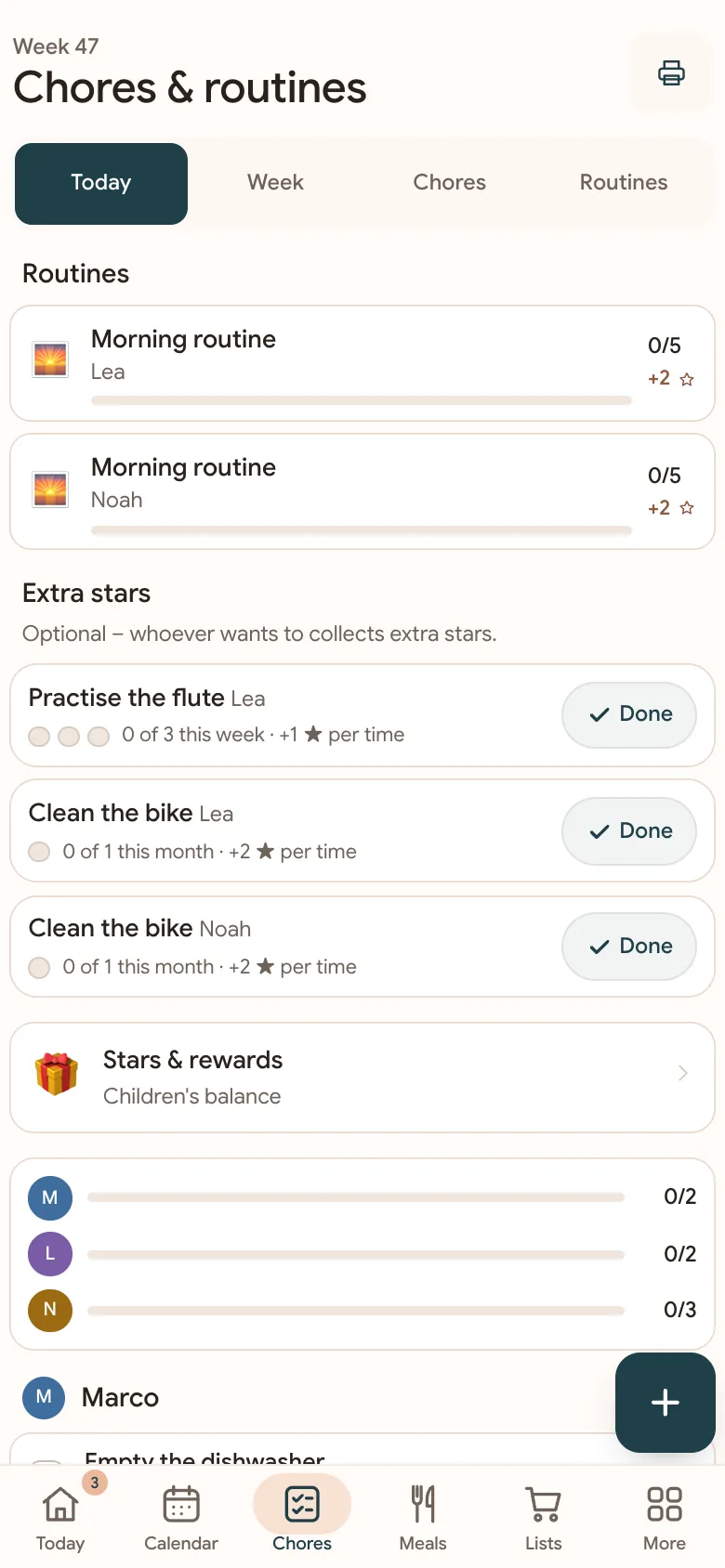
Prefer an app? Then the chore chart takes turns by itself.
In FamilyBuddy you set up the chores once – the app does the rest.
- Daily, weekly, every 2–4 weeks or monthly – and taking turns fairly without anyone having to work it out
- Children tick off chores themselves and collect stars for rewards you set – even without their own phone, with a code and PIN
- A reminder on the phone when a chore is due
- Still prefer paper? Print the chore chart for the fridge again every week
CHF 5 per month for the whole family, data in Switzerland. All features · Guide to chores

Frequently asked questions about the chore chart
At what age do chores make sense?
Children can help from the age of two or three, for example with tidying up or setting the table. A fixed chore that a child is responsible for on their own usually works from kindergarten.
How many chores should a child have?
Better a few that work: in kindergarten one or two small chores a day, at primary school two or three, plus a bigger one each week. Teenagers can take over a whole area, for example cooking once a week.
Should children be paid for chores?
Many experts advise against paying for everyday chores and recommend giving pocket money independently of them. For extra, bigger jobs such as washing the car, a little something on top is fine.
What if a child doesn't do their chore?
Remind calmly, don't punish. Often a chore is too hard, too boring or at the wrong time. Ask, swap it or do it together for a week. A fixed time, such as «straight after dinner», helps.
How do I share chores fairly between children of different ages?
Count the time, not the number. Older children take on bigger chores less often, younger ones smaller chores more often. Chores that everyone can do take turns daily or weekly.
Is the template free and do I need an account?
Yes, the template is free and needs no account. Your entries stay on your device only and are not sent anywhere. If you'd like the chart to take turns by itself, you can try FamilyBuddy free for a month.
Is there an app for the chore chart?
Yes. In the family app FamilyBuddy you set up the chores once, then they take turns fairly. Children tick them off themselves and collect stars – even without their own phone, with a code and PIN. The app runs in the browser on iPhone, Android, tablet and computer – no download from the App Store. The first month is free. Try for free
Further reading (in German): Beobachter: why chores matter · Famigros: chore chart for home